Dua Between Sujood In Arabic, English and Hadith
Reciting prayers between the two sujood is a confirmed tradition of the Prophet (peace and blessings be upon him). This practice is supported by multiple authentic hadiths.
Here are the duas in Arabic (original text), English (translation) and Transliteration (phonetic pronunciation).
1. What is Sujood?
Sujood (سُجود) literally means prostration, the act of lowering the forehead, nose, palms, knees and toes to the ground in complete submission to Allah. In ṣalāh it is the posture in which the worshipper is closest to his Lord; spiritually it is the apex of humility, and physically it is a moment of therapeutic stillness . The Qurʾān describes even the shadows of created things as “doing sujūd” in perfect obedience (16:48-50) .
2. The Moment Between the Two Sajdahs
After the first sajdah the worshipper sits briefly (the jalsah al-istirāḥah) before the second sajdah. This fleeting pause is mustaḥabb (recommended) for silent supplication. While not obligatory, it is a confirmed Sunnah that the Prophet ﷺ never omitted .
3. Authentic Dua’s Between Sujood
A. The Short Dua
Arabic
رَبِّ اغْفِرْ لِي، رَبِّ اغْفِرْ لِي
Transliteration: Rabbi ghfir lī, Rabbi ghfir lī
Translation: “My Lord, forgive me; my Lord, forgive me.”
Source: Sunan Abī Dāwūd 1/231; authenticated by al-Albānī .
B. The Comprehensive Dua
Arabic
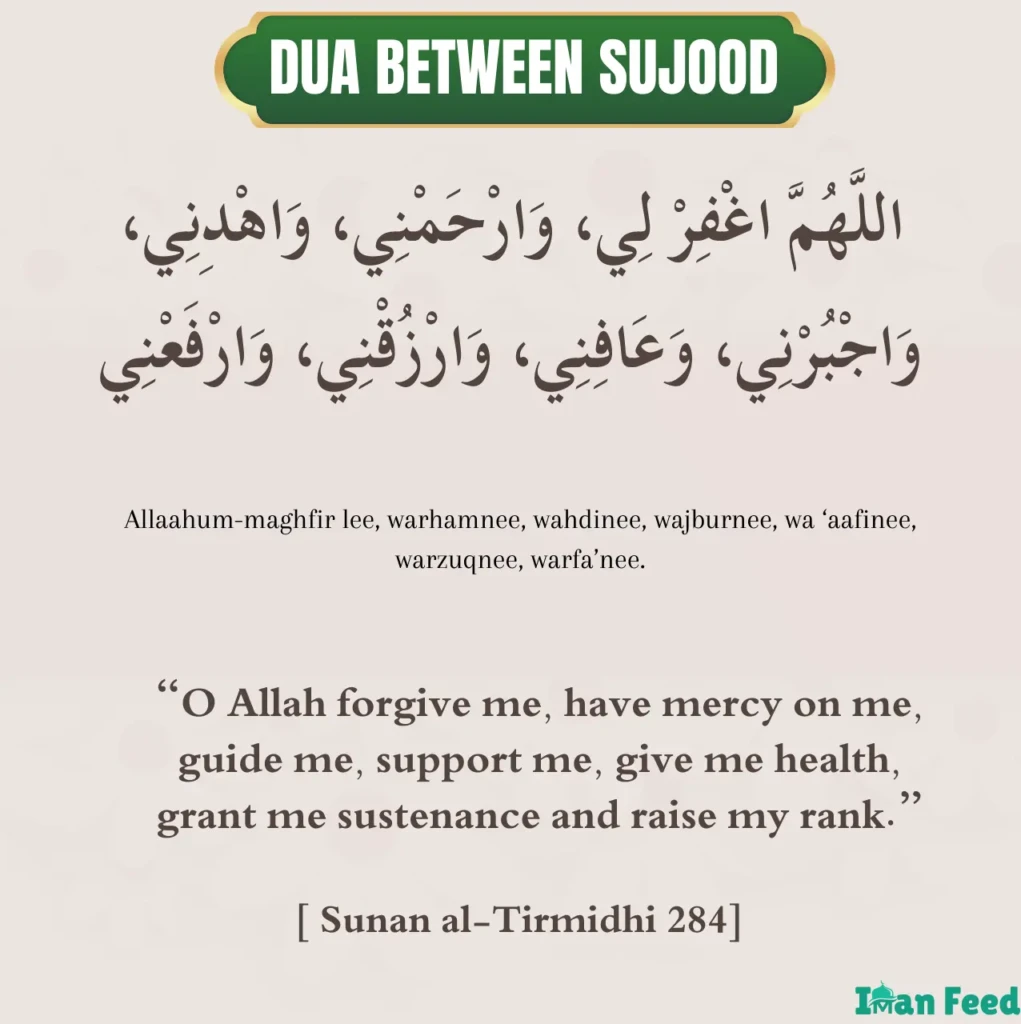
اللَّهُمَّ اغْفِرْ لِي، وَارْحَمْنِي، وَاهْدِنِي، وَاجْبُرْنِي، وَعَافِنِي، وَارْزُقْنِي، وَارْفَعْنِي
Transliteration: Allāhumma ghfir lī, warḥamnī, wahdinī, wajburnī, wa ʿāfinī, warzuqnī, warfaʿnī
Translation: “O Allah, forgive me, have mercy on me, guide me, support me, grant me wellbeing, provide for me, and raise my rank.”
Source: Abū Dāwūd, Ibn Mājah, At-Tirmidhī; classed ṣaḥīḥ by al-Albānī .
C. Variant Reported by Ibn ʿAbbās
ʿAbdullāh ibn ʿAbbās narrated that the Prophet ﷺ used to say between the two prostrations:
“Allāhumma ghfir lī, warḥamnī, wajburnī, wahdinī, warzuqnī.”
“O Allah forgive me, have mercy on me, restore me, guide me and provide for me.”
[Sunan at-Tirmidhī 284; authenticated chain , ].
Important Note: Qurʾānic āyāt and their translations are left exactly as revealed; no wording has been altered.
4. Ruling & Etiquette
- Ruling: Majority of scholars hold that any duʿāʾ between the two sajdahs is mustaḥabb (recommended) .
- Etiquette:
– Keep the supplication brief so that the prayer remains light.
– Face the Qiblah while sitting on the left foot with the right foot upright.
– Maintain khushūʿ (humility); it is a private conversation with Allah.
5. Personalising Your Duaʾ
While the prophetic wordings are best, a worshipper who does not know them may ask Allah in his or her own language. The Prophet ﷺ said:
“…then let him be abundant in duʿāʾ during the sujūd, for it is most likely to be answered.” [Muslim]
Thus parents, health, rizq, or any specific need may be added , .
6. Spiritual & Physical Benefits of This Brief Pause
| Spiritual | Physical |
|---|---|
| Humility: Recognising one’s need for forgiveness after every fall (sajdah). | Circulation: Sitting upright between prostrations promotes venous return. |
| Hope: Repeating “ghfir lī” implants optimism in divine mercy. | Flexibility: Alternating flexion-extension keeps joints supple. |
| Comprehensive Dua: Seven requests cover this life and the next. | Mindfulness: The short pause trains the heart to focus. |
7. Step-by-Step in Ṣalāh
- First Sajdah: Say Subḥāna Rabbiya-l-Aʿlā (3×).
- Rise to Jalsah: Sit calmly, palms on thighs, eyes on lap.
- Recite chosen duʿāʾ: either Rabbi ghfir lī or the longer version.
- Second Sajdah: Proceed immediately after the duʿāʾ.
8. Frequently Asked Questions
| Question | Answer |
|---|---|
| Is Arabic obligatory? | Arabic is preferred; other languages are allowed if one cannot manage Arabic. |
| Can I recite Qurʾān instead? | No, this moment is for duʿāʾ, not Qurʾān recitation. |
| How long should I sit? | The sitting should be equal to one tasbīḥah; avoid prolongation that resembles the sitting of forgetfulness. |
9. Recommended Resources for Memorisation
- Book: Hisn al-Muslim nos. 48-49.
- Audio App: “Dua Between Sujood – My Islam App” .
- Wall-chart: Place near prayer area with Arabic, transliteration and English.
10. Conclusion
The seconds between the two sajdahs are a hidden treasure—too brief to measure, yet vast enough to carry the believer’s every need to the Highest Heaven. By reviving this Sunnah we follow the footsteps of the Prophet ﷺ, turning every ṣalāh into a ladder of forgiveness, guidance and elevation.
“The closest a servant is to his Lord is while he is prostrating, so increase in supplication therein.” [Muslim]
References
: wikiHow – “What Is Sujood? Meaning, Best Dua, Types & Benefits” (2024-06-11)
: My Islam – “Dua Between Prostrations (2 Duʿās)” (2023-06-14)
: MATW Project Global – “Dua Between Sujood: A Guide to Connecting With Allah” (2024-06-12)
: Noor Academy – “Dua Between Two Sujood” (2025-02-04)
: Lamp of Islam – “Meaning of Sujud” (2025-01-31)