Dua for Wearing Clothes in Arabic, English & Transliteration
The Prophet Muhammad (peace be upon him) would say a special prayer when putting on his clothes (dua for wearing clothes).
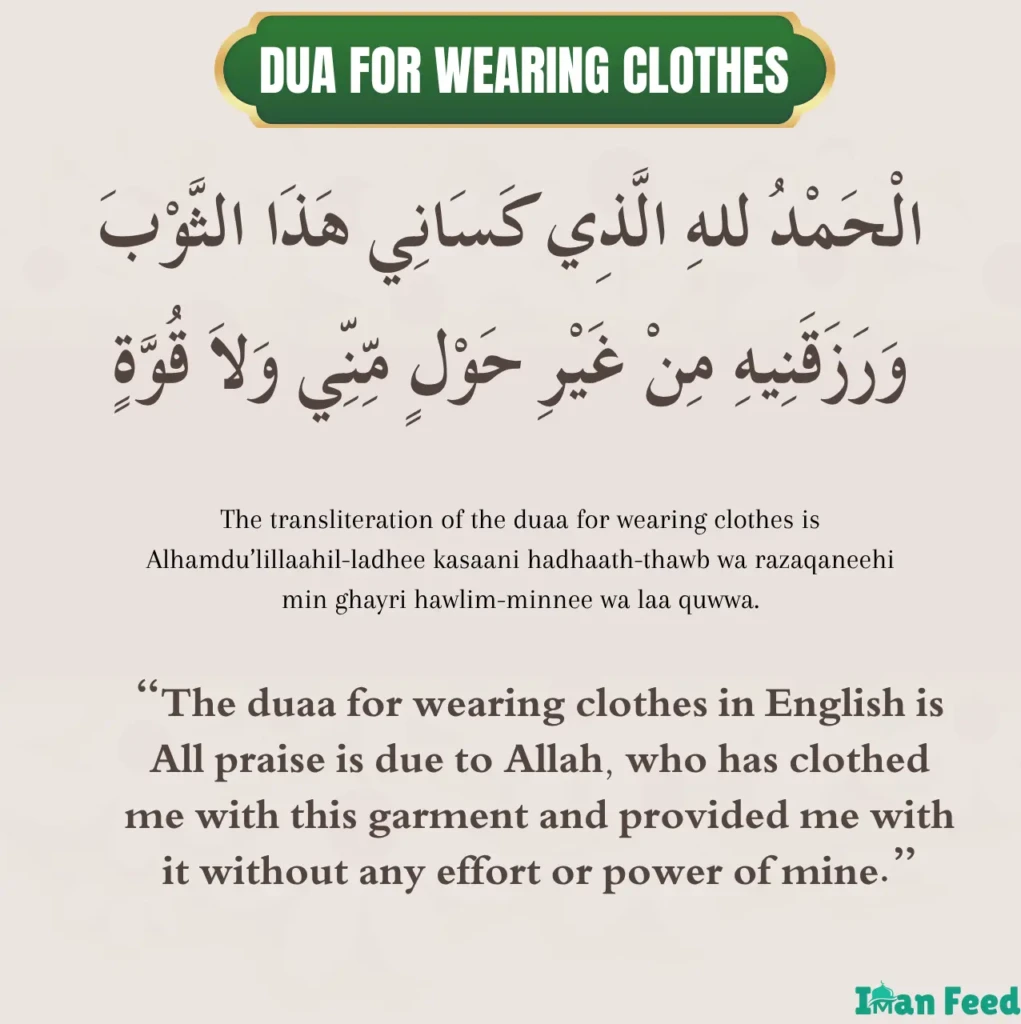
Remember to say this prayer when putting on your clothes to ask for Allah’s protection and blessings!
Dua for Wearing Clothes in Arabic
الْحَمْدُ للهِ الَّذِي كَسَانِي هَذَا الثَّوْبَ وَرَزَقَنِيهِ مِنْ غَيْرِ حَوْلٍ مِّنِّي وَلاَ قُوَّةٍ
Dua for Wearing Clothes Transliteration
The transliteration of the duaa for wearing clothes is Alhamdu’lillaahil-ladhee kasaani hadhaath-thawb wa razaqaneehi min ghayri hawlim-minnee wa laa quwwa.
Dua for Wearing Clothes in English
The dua for wearing clothes in English is All praise is due to Allah, who has clothed me with this garment and provided me with it without any effort or power of mine.
Hadith Text
On the authority of Mu’adh ibn Anas (رضي الله عنه): The Prophet (ﷺ) said, “Whoever wore a garment and then said: All Praise belongs to Allah, Who has clothed me with this (garment) and provided it for me, with no power nor might from myself,’ will be forgiven his previous sins.” [Recorded by Abu Dawood, no. 4023]
Shaykh Abdur-Razzaq al-Badr Explains the Prophet’s Prayer
When the Prophet Muhammad (peace be upon him) put on his clothes, he said, “Al-Hamdu-lil-lāh” (All praise belongs to Allah). This means praising Allah with our words for something beautiful or good that He has done voluntarily.
Imam Shawkani (may Allah have mercy on him) explained that “Al-Hamd” is different from “Shukr” (thanks). We say “Al-Hamd” to praise Allah’s perfection, even if we haven’t received a favor from Him. We say “Shukr” to thank Allah for a favor He has done for us.
The Prophet (peace be upon him) continued: “Who has clothed me with this garment and provided it for me?” Here, we are praising and thanking Allah for the blessing of clothing, which covers our private parts and beautifies our appearance.
Allah says in the Quran (7:26), “Clothing is a blessing, but the best clothing is the clothing of piety and righteousness.”
While clothing is a great blessing, we must avoid the evils that come with it, like pride and arrogance. We must beautify our inner selves with faith, good deeds, and the consciousness of Allah.
The Prophet (peace be upon him) ended his prayer by saying, “With no power nor might from myself.” This means we acknowledge our inability to create or provide blessings without Allah’s help. Every blessing we enjoy is a favor from Allah, given freely to His servants.
Islamic Dressing Etiquette
Here are some basic guidelines for dressing in Islam:
- Modesty: Cover your body properly, without revealing private parts.
- Loose Fitting: Wear loose clothes, not tight ones, to stay decent and humble.
- Length: Wear long clothes to cover your body adequately.
- Thickness: Wear thick clothes to avoid transparency.
- Non-Imitating: Don’t wear clothes that imitate the opposite gender.
- Unique Identity: Dress in a way that shows you’re a Muslim, without copying non-Muslim styles.
- Cleanliness: Keep your clothes clean and well-maintained, showing respect for yourself and others.
- Avoid Extravagance: Dress neatly, but avoid excessive spending or showiness.
- Covering Awrah: Cover your private parts (awrah). For men, this means from navel to knees, and for women, it’s the whole body except the face and hands.
- No Images or Symbols: Avoid clothes with images or symbols that go against Islamic principles.
Remember, these guidelines might be interpreted differently in various Islamic communities and cultures. If you have questions, ask knowledgeable sources or scholars for guidance.
Ultimately, personal reflection and a commitment to understanding the spirit, not just the letter, of Islamic teachings are key to navigating these complexities.