Allahumma Barik Laha & Lahu Meaning, Arabic, and Reply
In Islam, many phrases hold profound meanings that transcend their literal translations. One such example is “Allahumma Barik,” a widely used expression across Muslim communities worldwide.
While it’s commonly used to mark joyous occasions like new possessions, marriages, and the birth of a child, its deeper significance and proper usage may not be fully understood by all Muslims.
This article aims to explore the meaning and importance of “Allahumma Barik” in Islam, shedding light on its appropriate use and significance in our lives.
Allahumma Barik in Arabic Text
Allahumma Barik is written in Arabic as:
اللّهُـمَّ بارِكْ
Allahumma Barik Meaning in English
“Allahumma Barik” (اللهم بارك) is an Arabic phrase that means “O Allah, bless” or “O Allah, shower Your blessings upon”. It is a supplication (du’a) asking Allah to bestow His blessings, grace, and goodness upon something or someone.
In essence, when you say “Allahumma Barik”, you are requesting Allah to:
- Bless and protect
- Show favor and mercy
- Grant abundance and prosperity
- Shower His grace and kindness
This phrase is often used in various situations, such as:
- Expressing gratitude and appreciation
- Seeking blessings and protection
- Celebrating joyous occasions (like weddings, new births, or new possessions)
- Asking for divine favor and guidance
Remember, the phrase “Allahumma Barik” is a heartfelt supplication, and its meaning goes beyond a simple translation. It’s a way to connect with Allah and seek His blessings in all aspects of life.
Allahumma Barik Laha in Arabic
The phrase is written in Arabic as;
اللّهُـمَّ بارِكْ لَها
Allahumma Barik Laha Meaning in English
Allahumma barik laha means oh Allah, bless her or May Allah bless her. It is used only for girl or female.

Allahumma Barik Lahu in Arabic
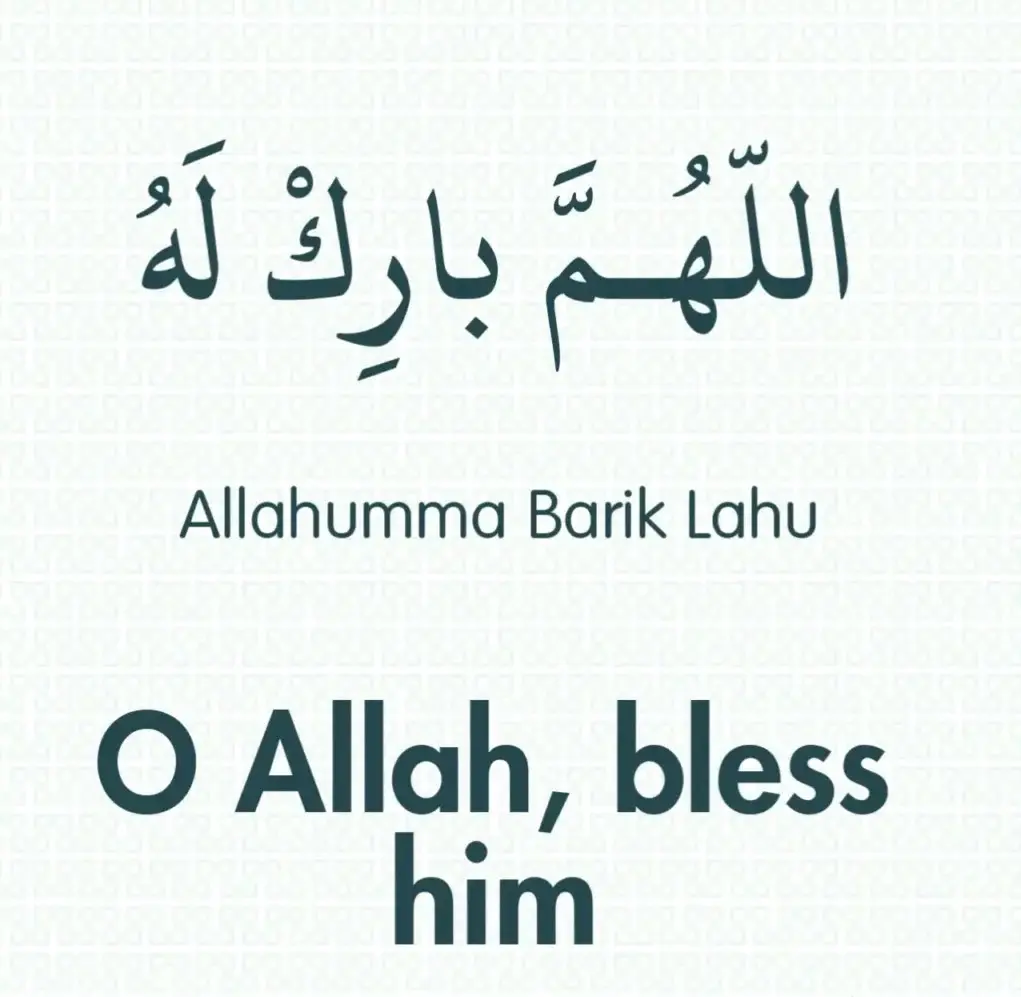
اللّهُـمَّ بارِكْ لَهُ
Allahumma Barik Lahu Meaning in English
Allahumma barik lahu means oh Allah, bless him or May Allah bless him. It is only used for boy or male.
Other ways to say Allahumma Barik:
| Person | Arabic | Transliteration | English Meaning |
| Male (one) | اللّهُـمَّ بارِكْ لَه | Allahumma Barik Lahu | O Allah, bless him |
| Female (one) | اللّهُـمَّ بارِكْ لَها | Allahumma Barik Laha | O Allah, bless her |
| Male (plural) | اللّهُـمَّ بارِكْ لَهُم | Allahumma Barik Lahum | O Allah, bless them |
| Female (plural) | اللّهُـمَّ بارِكْ لَهُنَّ | Allahumma Barik Lahun | O Allah, bless them |
How To Reply To Allahumma Barik
You can respond to “Allahumma Barik” by saying “Ameen” or by expressing your gratitude with phrases like “JazakAllah Khair” (May Allah reward you with goodness).
When a person says ”may Allah bless it or you” the respond should be Ameen since it is Dua or Ameen Wa iyaak (and to you too) for male and Ameen Wa iyaaki’ (and to you too) for female.
You can say also say May Allah (SWT) bless you with the same (whatever they asked for you) and end it with ”Aameen”
Saying Ameen to dua is prescribed in Sunnah. According to the Sunnah, the one who hears the du’aa’ and would like to be one of those who are included in it, should say Ameen.
By doing so he is asking his Lord to answer this du’aa’ and fulfil what is in it, for He is the best of those who are asked.
So, when someone says “Allahumma Barik” to you, a suitable response would be:
- “Amin” (آمين) meaning “Ameen” or “May it be so”
- “Barakallah” (بارك الله) meaning “May Allah bless you too” or “Allah bless you”
- “Wa barakallah feek” (و بارك الله فيك) meaning “And may Allah bless you too” or “Allah bless you as well”
These responses acknowledge the person’s supplication and invoke Allah’s blessings upon them as well. It’s a way to show appreciation and return the kindness, while also seeking Allah’s blessings for yourself.
When to Use Allahumma Barik
“Allahumma Barik” is a versatile supplication that can be used in various situations, including:
- Celebrating joyous occasions:
- Weddings: “Allaahumma Barik upon the newlyweds.”
- New births: “Allaahumma Barik upon the newborn.”
- New possessions: “Allaahumma Barik upon your new home/car/etc.”
- Expressing gratitude:
- “Allaahumma Barik for this blessing.”
- “Allaahumma Barik for your kindness.”
- Seeking blessings:
- “Allaahumma Barik upon our gathering/meeting.”
- “Allaahumma Barik upon our food/meal.”
- Showing appreciation:
- “Allaahumma Barik for your help/support.”
- “Allaahumma Barik for your guidance.”
- Asking for protection:
- “Allaahumma Barik upon us/our family/our community.”
What Is The Difference Between Allahumma Barik And Masha Allah?
“Allahumma Barik” and “Masha Allah” are both Arabic phrases used in Islam, but they have different meanings and uses:
- “Allahumma Barik” (اللهم بارك) means “O Allah, bless” or “O Allah, shower Your blessings upon”. It’s a supplication (du’a) asking Allah to bestow His blessings, grace, and goodness upon something or someone.
- “Masha Allah” (ما شاء الله) means “God has willed it” or “As Allah has wished“.
Key differences:
Allahumma Barik Usage: Invoking Allah’s blessings and seeking His favor upon a person, event, or situation. Example: “You bought a new car? Allahumma Barik, may it bring you blessings.”
Masha Allah Usage: Expressing admiration or appreciation for something good, often to acknowledge achievements without attributing them solely to personal efforts. Example: “You completed the project so efficiently, Masha Allah.”
In summary, “Allaahumma Barik” is a supplication seeking Allah’s blessings, while “Masha Allah” is an acknowledgment of Allah’s will and expressing admiration for something positive.
Allahumma Barik or Mashallah
According to scholars, it is permissible to supplicate with Allaahumma barik, as a protection against evil eyes, by asking blessings or saying Ma Shaa’ Allah; both are permissible.
Hadith On Allah Humma Barik
There are number of hadiths which mention this phrase and this includes:
- Hadith
It was narrated from Aqil bin Abu Talib: that he married a woman from Banu Jusham, and they said: “May you live in harmony and have many sons.” He said: “Do not say that, rather say what the Messenger of Allah said: ‘Allahumma barik lahum wa barikalaihim (O Allah, bless them and bestow blessings upon them).’Sunan Ibn Majah 1906
Allahumma barik lahum wa barik alaihim in Arabic
Here is how to write this Dua in Arabic:
اللَّهُمَّ بَارِكْ لَهُمْ وَبَارِكْ عَلَيْهِمْ
Meaning in English: The meaning is O Allah, bless them and bestow blessings upon them.
- Hadith
Narrated Abdullah ibn Abbas: I was in the house of Maymunah. The Messenger of Allah (ﷺ) accompanied by Khalid ibn al-Walid entered. Two roasted long-tailed lizards (dabb) placed on the sticks were brought to him.
The Messenger of Allah (ﷺ) spat. Khalid said: I think that you abominate it, Messenger of Allah. He said: Yes. Then the Messenger of Allah (ﷺ) was brought milk, and he drank (it). The Messenger of Allah (ﷺ) then said: When one of you eats food, he should say:
O Allah, bless us in it, and give us food (or nourishment) better than it. When he is given milk to drink he should say: O Allah! bless us in it and give us more of it, for no food or drink satisfies like milk.Sunan Abi Dawud 3730
اللَّهُمَّ بَارِكْ لَنَا فِيهِ وَأَطْعِمْنَا خَيْرًا مِنْهُ
Meaning: O Allah, bless us in it, and give us food (or nourishment) better than it.
اللَّهُمَّ بَارِكْ لَنَا فِيهِ وَزِدْنَا مِنْهُ
Meaning: O Allah! bless us in it and give us more of it.
When to say Allaahumma barik
The Prophet (blessings and peace of Allah be upon him) instructed the Muslim, if he sees something with his Muslim brothers that he admires, to pray for blessing (barakah) for them. The Prophet (blessings and peace of Allah be upon him) said:
“If one of you sees something with his brother that he admires, let him pray for blessing (barakah) for him.” Narrated by Imam Malik in al-Muwatta (2/939), Imam Ahmad in al-Musnad (25/355), and Ibn Majah (3509)
Ibn al-Qayyim (may Allah have mercy on him) said: “If the one who is looking fears that he could cause harm by his evil eye to the object that he is looking at, then he may ward off its evil by saying “Allaahumma barik ‘alayhi (O Allah, bless it for him),” as the Prophet (blessings and peace of Allah be upon him) said to ‘Amir ibn Rabi‘ah, when he looked at Sahl ibn Hunayf: “Did you not pray for barakah for him?” – In other words did you not say “Allahumma barik ‘alayhi (O Allah, bless it for him)”?” Zad al-Ma‘ad, 4/156
Ibn ‘Abd al-Barr (may Allah be pleased with him) stated that this is obligatory, when he said: “The words of the Messenger of Allah (blessings and peace of Allah be upon him),
“Did you not pray for barakah for him?”, indicate that the evil eye does not cause any harm if the one who looks at a thing prays for barakah for it; it can only cause harm if he does not offer supplication. So what is required of everyone who admires a thing is to pray for barakah for it. If he prays for barakah, that will inevitably ward off what is feared of harm. And Allah knows best.” At-Tamhid, 6/240-241
Al-Manaawi said in his book Faydh Al-Qadeer: “The term, ‘let him supplicate for blessing’, suggests the recommendation of saying, ‘O Allah, bless him and do not cause harm to him (Allaahumma Baarik Lahu wa la Tadhurruh),’ and also, ‘That which Allah wills (happens), there is no might except with Allah (Ma Shaa’ Allah, La Quwwata Illa Billaah)!’”