7 Beautiful Dua After Eating in Arabic, English and Hadith
One of the great Sunnahs that Prophet Muhammad (peace be upon him) taught is to thank Allah after eating(Dua After Eating). These prayers thank Allah for all of his bounties and help us stay connected to our Creator throughout the day.
The spiritual meaning of dua after meals
There are several spiritual reasons to say duas after eating. It turns the ordinary act of eating into an act of prayer, reminding us that Allah has blessed us with every bite we take. These prayers help us be more aware and thankful, which stops us from taking Allah’s gifts for granted. The Prophet (peace be upon him) stressed how important it is to remember Allah in all situations. Saying duas before meals is a good method to do this.
7 Duas After Eating with References
1. Dua of Gratitude
Arabic:
الْحَمْدُ لِلَّهِ كَثِيرًا طَيِّبًا مُبَارَكًا فِيهِ، غَيْرَ مَكْفِيٍّ، وَلاَ مُوَدَّعٍ وَلاَ مُسْتَغْنًى عَنْهُ، رَبَّنَا
Transliteration:
Al-hamdu li l-lah kathiran taiyiban mubarakan fihi ghaira makfiy wala muWada` wala mustaghna’anhu Rabbana.
English Translation:
“Praise be to Allah, much good and blessed praise. O our Lord, You are not in need of anyone, and we cannot do without Your favour nor dispense with it.”
Reference: Sahih al-Bukhari 5458

Abu Umama (may Allah be pleased with him) said that the Prophet (peace be upon him) would often say this long dua after a meal.
2. Acknowledgment of Divine Provision
Arabic:
الْحَمْدُ لِلَّهِ الَّذِي أَطْعَمَنِي هَذَا وَرَزَقَنِيهِ مِنْ غَيْرِ حَوْلٍ مِنِّي وَلاَ قُوَّةٍ
Transliteration:
Al-hamdu Lillahi alladhi at’amani hadha wa razaqnihi min ghayri hawlin minni wa la quwwah.
English Translation:
“Praise be to Allah Who has fed me this and provided me with it with no power or strength on my part.”
Reference: Narrated by al-Tirmidhi, 3458
According to the hadith told by Mu’adh ibn Anas, this dua promises to forgive past misdeeds.
3. Gratitude for Complete Nourishment
Arabic:
الْحَمْدُ لِلَّهِ الَّذِي أَطْعَمَ وَسَقَى وَسَوَّغَهُ وَجَعَلَ لَهُ مَخْرَجًا
Transliteration:
Al-hamdu Lillah alladhi at’ama wa saqa wa sawwaghahu wa ja’ala lahu makhrajan.
English Translation:
“Praise be to Allah Who has given food and drink, made it easy to swallow and provided an exit for it.”
Reference: Narrated by Abu Dawud, 3851
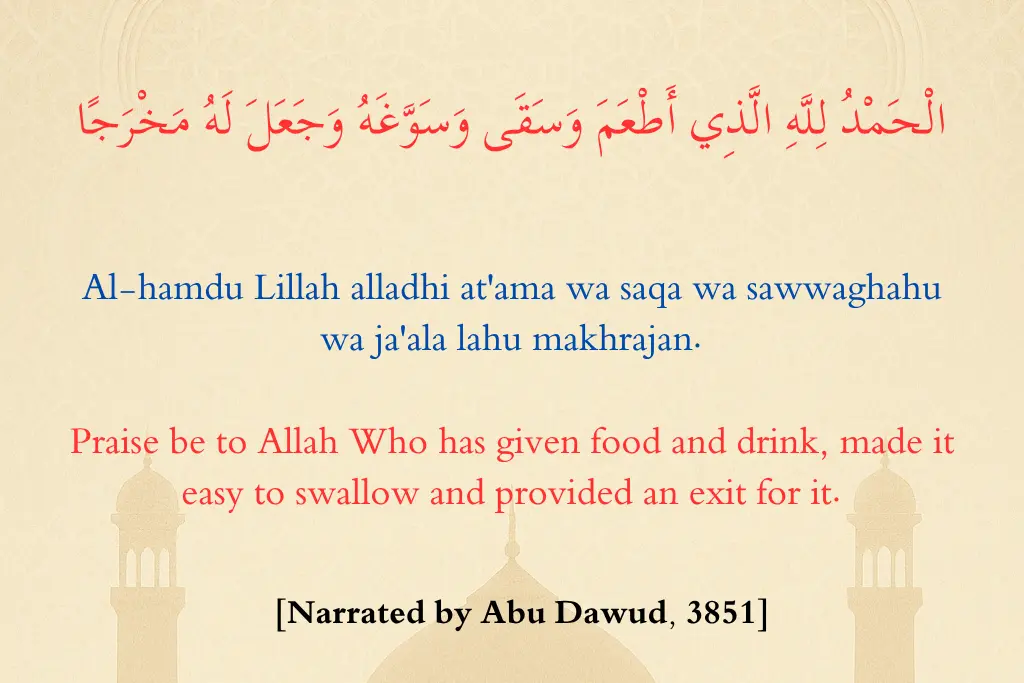
This dua, reported by Abu Ayyub al-Ansari (may Allah be pleased with him), acknowledges Allah’s complete care for our digestive process.
4. Comprehensive Praise for All Blessings
Arabic:
اللَّهُمَّ أَطْعَمْتَ وَأَسْقَيْتَ، وَأَغْنَيْتَ وَأَقْنَيْتَ، وَهَدَيْتَ وَأَحْيَيْتَ، فَلَكَ الْحَمْدُ عَلَى مَا أَعْطَيْتَ
Transliteration:
Allahumma at’amta wa asqayta wa hadayta wa ahyayta, fa laka’l-hamd ‘ala ma a’tayta.
English Translation:
“O Allah, You have fed, given to drink, guided and brought to life, so praise be to You for what You have given.”
Reference: Narrated by Ahmad, 16159
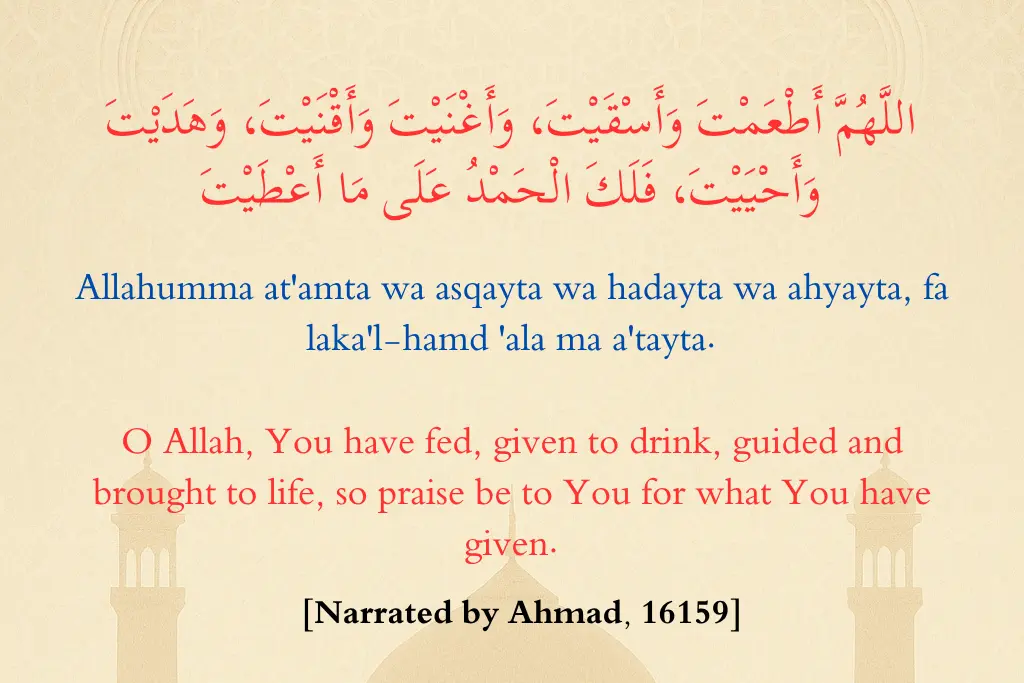
This dua thanks Allah for both financial and spiritual rewards and recognizes his role in guiding individuals and giving them life.
5. Prayer for Continued Blessings
Arabic:
اللَّهُمَّ بَارِكْ لَنَا فِيهِ وَأَطْعِمْنَا خَيْرًا مِنْهُ
Transliteration:
Allahumma barik lana fihi, wa at’imna khayran minhu.
English Translation:
“O Allah, bless it for us and feed us with better than it.”
Reference: Narrated by al-Tirmidhi, 3455

Ibn ‘Abbas (may Allah be pleased with him) reported this dua, which combines gratitude with a prayer for continued sustenance.
6. Simple Blessing Invocation
Arabic:
بِسْمِ اللَّهِ، وَعَلَى بَرَكَةِ اللَّهِ
Transliteration:
Bismillah, wa ‘ala barakatillah.
English Translation:
“In the name of Allah, and upon the blessing of Allah.”
Reference: Sunan Abi Dawud
This concise dua can be recited both before and after eating, invoking Allah’s blessings throughout the meal.
7. Seeking the Best of Prophetic Supplications
Arabic:
اللَّهُمَّ إِنِّي أَسْأَلُكَ مِنْ خَيْرِ مَا سَأَلَكَ مِنْهُ نَبِيُّكَ وَعَبْدُكَ مُحَمَّدٌ
Transliteration:
Allahumma inni as’aluka min khayri ma sa’alaka minhu nabiyyuka wa ‘abduka Muhammad.
English Translation:
“O Allah, I ask You for the best of what Your Prophet and servant Muhammad asked You for.”
Reference: Hadith Qudsi
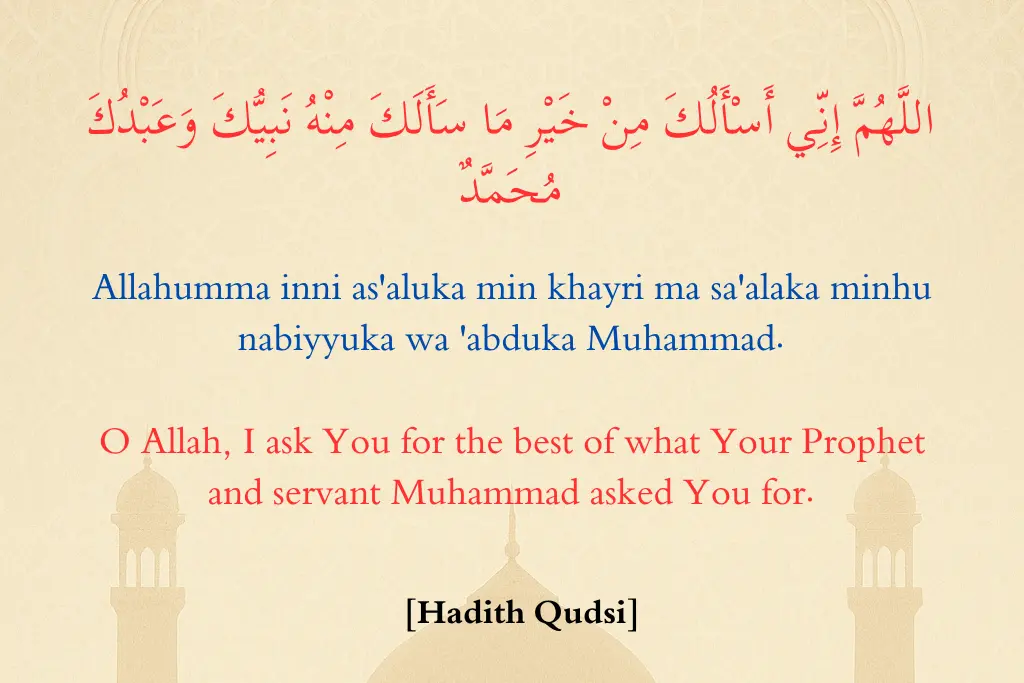
This dua links us directly to the prophetic tradition of asking Allah for help and the best things in life.
The Wisdom Behind Varying Your Duas
Islamic scholars say that instead of always saying the same dua, you should switch between them. This practice has a few different goals:
Spiritual Benefits: Changing your prayers keeps you from saying them in a mechanical way and helps you stay conscious of what you’re saying. Every dua has its own special significance and blessings that make our spiritual lives better.
Following Complete Sunnah: We follow the Prophet’s whole example and get the full range of his teachings by employing different authentic duas.
More Reflection: Different ways of saying things help us think on different parts of Allah’s gifts, from fundamental needs to spiritual guidance and life itself.
Etiquettes of Eating in Islamic Tradition
Before the Meal
- Cleanliness: Wash your hands well before you eat to stay clean and follow the teachings of the Prophet.
- Be Quick to Eat: When your host offers you food, be quick to accept and start eating. This shows appreciation for their hospitality and helps put them at ease.
- Start with “Bismillah,” which means “In the name of Allah.” If you forget, say “Bismillahi awwalahu wa akhirahu” (In the name of Allah at the beginning and at the end).
- Proper Positioning: Sit up straight and eat with your right hand, taking food from your own plate.
During the Meal
- Be mindful of what you eat. When you can, eat with three fingers, chew your food well, and don’t waste it.
- Eat from Your Share: Take food from what’s directly in front of you, not from someone else’s portion or the middle of the platter.
- Social Etiquette: When eating with others, be polite and keep the conversation pleasant.
- Moderation: Follow the prophetic advice to fill one-third of your stomach with food, one-third with drink, and leave one-third empty for air.
After the Meal
- Hand Washing: You should wash your hands and lips after eating, even if you are already clean.
- Say the right duas with a full heart and real thanks.
- Don’t waste food: if it falls, clean it up and eat it, knowing that there may be benefits in what looks small.
The Broader Context of Islamic Gratitude
These prayers after meals are part of Islam’s all-encompassing way of living mindfully. They turn everyday tasks into chances to connect with the divine and remind us that every blessing, no matter how tiny, should be recognized. There are several real duas to choose from, which gives you options while yet keeping the important sense of thankfulness that is a part of Islamic devotion.
Reciting duas after eating is an example of how Islam combines the spiritual and practical parts of life. It makes sure that even our most basic necessities become times to remember and thank Allah. Being conscious of God’s providence all the time helps us have a grateful heart and enhances our relationship with our Creator every day.