Surah Al-Fatiha with English Transliteration and Translation
Surah Al-Fatiha is the opening chapter of the Holy Quran and holds immense significance in Islamic worship. Known as “The Opening,” this seven-verse chapter forms the foundation of every Muslim’s daily prayers and is considered the key to the entire Quran.
Arabic Text, Transliteration, and Translation
Arabic Text Surah Al-Fatiha
بِسْمِ اللَّهِ الرَّحْمَـٰنِ الرَّحِيمِ
الْـحَمْدُ لِلَّهِ رَبِّ الْعَالَمِينَ
الرَّحْمَـٰنِ الرَّحِيمِ
مَالِكِ يَوْمِ الدِّينِ
إِيَّاكَ نَعْبُدُ وَإِيَّاكَ نَسْتَعِينُ
اهْدِنَا الصِّرَاطَ الْمُسْتَقِيمَ
صِرَاطَ الَّذِينَ أَنْعَمْتَ عَلَيْهِمْ
غَيْرِ الْمَغْضُوبِ عَلَيْهِمْ وَلَا الضَّالِّينَ

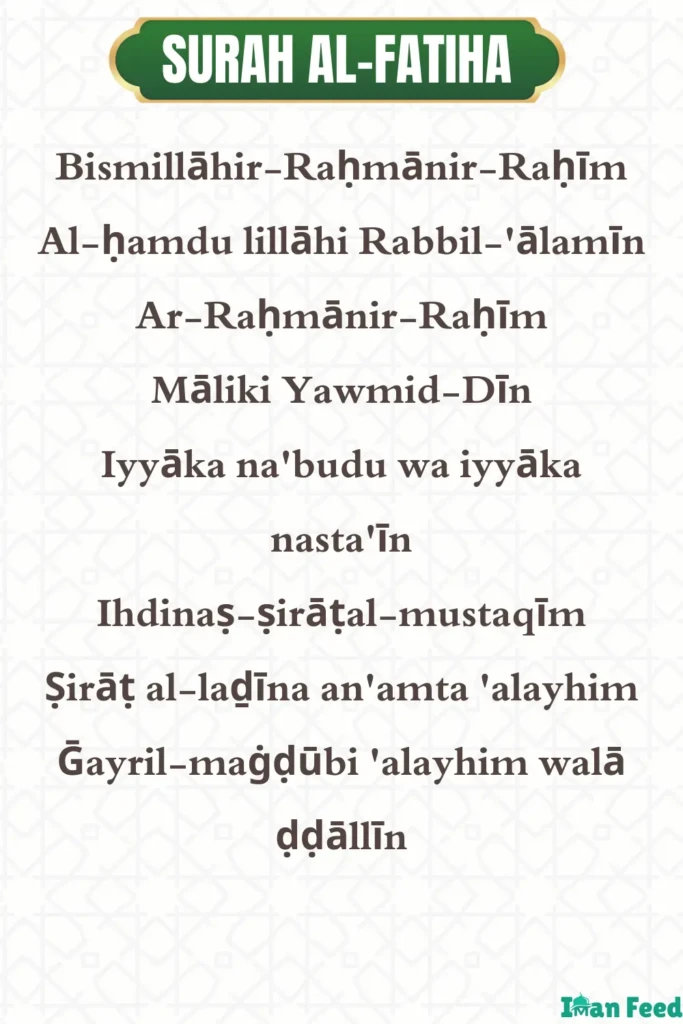
English Transliteration Surah Al-Fatiha:
Bismillāhir-Raḥmānir-Raḥīm
Al-ḥamdu lillāhi Rabbil-‘ālamīn
Ar-Raḥmānir-Raḥīm
Māliki Yawmid-Dīn
Iyyāka na’budu wa iyyāka nasta’īn
Ihdinaṣ-ṣirāṭal-mustaqīm
Ṣirāṭ al-laḏīna an’amta ‘alayhim
Ḡayril-maġḍūbi ‘alayhim walā ḍḍāllīn
English Translation Surah Al-Fatiha:
In the name of Allah, the Most Merciful, the Most Kind.
All praise is for Allah, the Lord of all worlds.
The Most Merciful, the Most Kind.
Master of the Day of Judgment.
You alone we worship and You alone we ask for help.
Guide us along the Straight Path,
The path of those You have blessed—
not those You are displeased with, or those who are astray.
Verse-by-Verse Surah Al-Fatiha
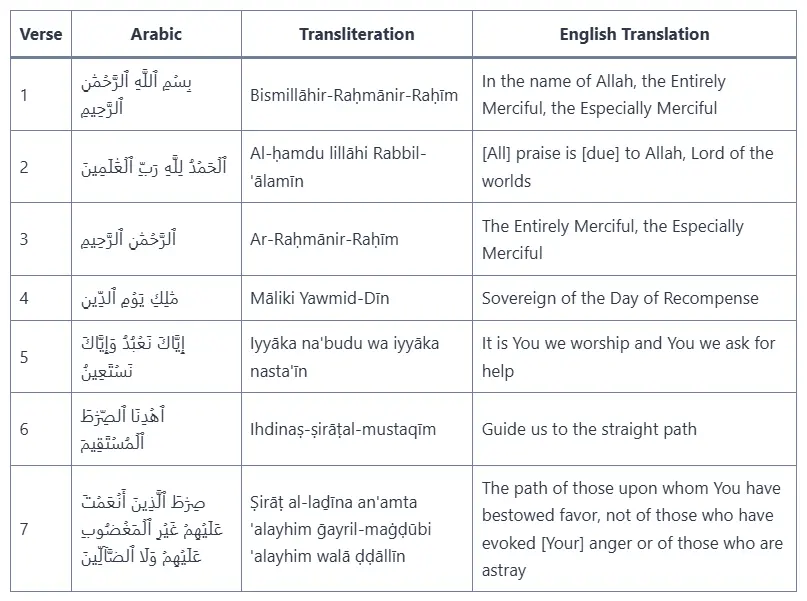
| Verse | Arabic | Transliteration | English Translation |
|---|---|---|---|
| 1 | بِسۡمِ ٱللَّهِ ٱلرَّحۡمَٰنِ ٱلرَّحِيمِ | Bismillāhir-Raḥmānir-Raḥīm | In the name of Allah, the Entirely Merciful, the Especially Merciful |
| 2 | ٱلۡحَمۡدُ لِلَّهِ رَبِّ ٱلۡعَٰلَمِينَ | Al-ḥamdu lillāhi Rabbil-‘ālamīn | [All] praise is [due] to Allah, Lord of the worlds |
| 3 | ٱلرَّحۡمَٰنِ ٱلرَّحِيمِ | Ar-Raḥmānir-Raḥīm | The Entirely Merciful, the Especially Merciful |
| 4 | مَٰلِكِ يَوۡمِ ٱلدِّينِ | Māliki Yawmid-Dīn | Sovereign of the Day of Recompense |
| 5 | إِيَّاكَ نَعۡبُدُ وَإِيَّاكَ نَسۡتَعِينُ | Iyyāka na’budu wa iyyāka nasta’īn | It is You we worship and You we ask for help |
| 6 | ٱهۡدِنَا ٱلصِّرَٰطَ ٱلۡمُسۡتَقِيمَ | Ihdinaṣ-ṣirāṭal-mustaqīm | Guide us to the straight path |
| 7 | صِرَٰطَ ٱلَّذِينَ أَنۡعَمۡتَ عَلَيۡهِمۡ غَيۡرِ ٱلۡمَغۡضُوبِ عَلَيۡهِمۡ وَلَا ٱلضَّآلِّينَ | Ṣirāṭ al-laḏīna an’amta ‘alayhim ḡayril-maġḍūbi ‘alayhim walā ḍḍāllīn | The path of those upon whom You have bestowed favor, not of those who have evoked [Your] anger or of those who are astray |
Less-than-3-minute Tafseer:
- Bismillah – Begin every lawful action—email, meal, drive—with Allah’s name; it becomes an act of worship.
- Al-ḥamd – Say “Al-ḥam-du-lil-lāh” out loud when you wake up; neuroscience shows gratitude raises serotonin within minutes.
- Raḥmān & Raḥīm – Before you speak to anyone, remind yourself Allah’s mercy is bigger than your anger.
- Mālik of the Day of Judgement – Ask: Will this post, purchase, or argument look good on that Day?
- Iyyāka na‘bud… – Check your day-planner: does it prove worship is only for Allah—no skipped ṣalāh for a Netflix binge?
- Ihdinā… – End the night with two rak‘ahs and this verse as your dua; the Prophet ﷺ did exactly that.
- Ṣirāṭ… – Follow one sunnah of the Prophet ﷺ daily; that is the blessed path.
Common mistakes non-Arabs make (and how to fix them)
| Mistake | Why it happens | Quick fix |
|---|---|---|
| Saying “Alhamdulillaa-hi rabbil…” with a hard “h” in Rabb | Confusing ح with ه | Place your tongue further back; whisper “rabb” like you’re fogging a mirror. |
| Running “Ar-Raḥmānir-Raḥīm” into one word | Missing the glottal stop | Pause after Ar-Raḥmān; say the next word as a fresh breath. |
| Stressing yaw-mid-din as yawm-ul-din | Misplacing the shaddah | Put a tiny stress on the doubled d: “yawm-mid-din”. |
The Significance of “Alhamdulillahi Rabbil Alamin”
The second verse’s phrase “Alhamdulillahi Rabbil Alamin” (الْحَمْدُ لِلَّهِ رَبِّ الْعَالَمِينَ) is very important. This phrase means “Praise be to Allah, the Lord of the Universe” and shows the most important thing about Islam: that Allah is the highest authority.
Alternative transliterations include:
- Alhamdulillah, the Lord of the Worlds
- alhamdulillah rabbil alamin
- Alhamdulillahi Rabbil Alamin
- alhamdulillahirobbil alamin
Names and Significance of Surah Al-Fatiha
There are many names for Surah Al-Fatiha, each of which shows how important it is:
- Al-Fatiha (The Opening) – it opens the Quran
- Umm al-Kitab (Mother of the Book) is the Quran’s base.
- As-Sab’ al-Mathani (The Seven Oft-Repeated Verses) are read in every unit of prayer.
- Al-Shifa (The Cure) is known for its therapeutic abilities.
- Al-Ruqia (Protection) is a way to protect your spirit.
Main Ideas and Meanings
Three Basic Principles
Surah Al-Fatiha lays out the three main ideas of Islamic faith:
- Tawheed (The Oneness of Allah)
- Prophethood (Believing in Allah’s messengers)
- Akhirah (Belief in the Afterlife)
Spiritual Structure
The surah has a defined spiritual path:
- Verses 1–4: Praise and recognition of Allah’s qualities
- Verse 5: Saying that you worship and need support
- Verses 6–7: Asking for help and guidance
Significance in Daily Prayer
In every unit (rakaat) of the five daily prayers, Muslims must say Surah Al-Fatiha at least once. The Prophet Muhammad (peace be upon him) said that it is the “greatest Surah in the Quran” and that prayers without it are not legitimate.
Practical Benefits
- Spiritual connection: lets the believer talk directly to Allah
- Daily guidance: Gives you a way to ask for divine help
- Protection and healing: Traditionally used for spiritual healing and protection
- Help with memorization: Its rhythmic nature makes it easier to remember.
Memorize Surah Al-Fatiha in 7 days
Day-plan (5 min/day)
- Listen to the audio above while reading the phonetic column.
- Cover the Arabic and read only the transliteration—out loud.
- Cover both and recite from memory; check one line at a time.
- Add the next verse and repeat.
By the seventh day you’ll recite all seven verses confidently in ṣalāh.
Conclusion
Reading Surah Al-Fatiha is more than just a prayer; it’s a petition for help and mercy for the rest of your life. This guide advantages. This will help you connect more deeply with the Quran. Add it to your daily routine to foster spiritual growth. For more information, refer to real Quran apps or consult scholars.
If this guide helped you, share it with one person before the next prayer—each time they recite Al-Fātiḥah, you harvest the same reward.
Barakallāhu fīkum.